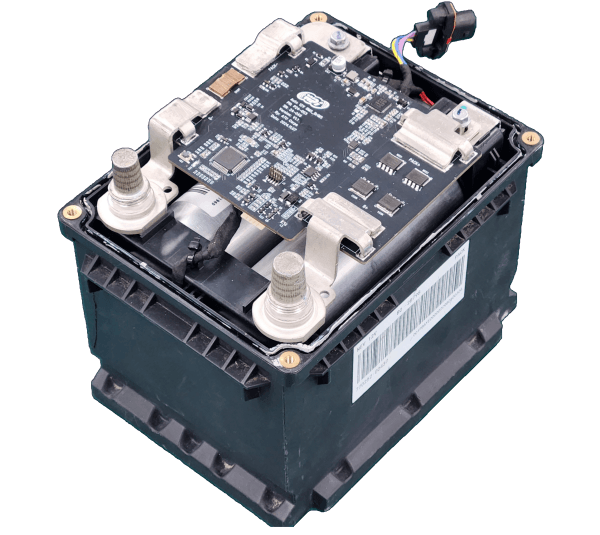
Why Are Lithium Batteries Indispensable to a BMS? Does Your Battery Truly Lack This "Personal Butler"—the Battery Management System?
Apr 29, 2026
Why Must Lithium Batteries Be Equipped with a BMS? — Just How Dangerous Are Overcharging, Over-discharging, Short Circuits, and Overheating?
Lithium batteries boast high energy density, but they also have a volatile temperament.
Overcharging: If the voltage exceeds 4.2V, metallic lithium precipitates internally; in mild cases, the battery swells (bloats), while in severe cases, it catches fire. Many instances of electric scooters catching fire while charging are the result of a BMS failure leading to overcharging.
Over-discharging: If the voltage drops below 2.5V, the copper foil dissolves, and the battery essentially "dies in its sleep." If you have a drone or an old power bank that has been sitting unused at home for a long time and refuses to charge, it is most likely due to over-discharging.
Short Circuits: If the positive and negative terminals accidentally come into contact, the instantaneous current can surge to hundreds of amperes; temperatures skyrocket, and the electrolyte ignites.
Overheating: High temperatures or high-current charging and discharging accelerate aging and can even trigger "thermal runaway," resulting in the complete destruction of the entire battery pack.
Precisely because lithium batteries harbor these inherent safety risks, they must be paired with a "butler" that remains on duty 24/7—the BMS (Battery Management System)—to constantly monitor conditions and cut off power whenever necessary.
2. What Are the Five Core Functions of a BMS? — Monitoring, Protection, Balancing, Estimation, and Communication
If we were to liken the BMS to a personal bodyguard, it would possess at least these five essential skills:
Monitoring: It collects real-time data on the voltage, current, and temperature of every single battery cell—doing so dozens of times per second—ensuring that no anomaly, however slight, escapes its watchful eye.
Protection: Upon detecting overvoltage, undervoltage, overcurrent, or overheating, it immediately severs the circuit—"pulling the plug" within milliseconds—thereby nipping the danger in the bud.
Balancing: It ensures that the battery cells connected in series "work together in harmony." This is achieved through either *passive balancing* (using resistors to dissipate excess energy—a low-cost method) or *active balancing* (transferring energy between cells—a highly efficient method). Without balancing, the overall lifespan of the entire battery pack would be dragged down to the level of its weakest individual cell.
Estimation: It tells you exactly how much power remains (the State of Charge, or SOC). This figure is not obtained through direct measurement, but rather through estimation using algorithms such as ampere-hour integration and Kalman filtering. If you notice the driving range of your electric vehicle suddenly dropping significantly during the winter, it doesn't mean the battery is broken; it simply means the BMS has adjusted its estimation model to account for the lower temperatures.
Communication: Reporting Battery Status to the Host System—Whether an electric vehicle uses a CAN bus to inform its Vehicle Control Unit (VCU), or a smartphone uses I²C to communicate with its main processor, it is this communication link that allows that little battery icon on your screen to light up.
These five core functions collectively constitute a complete Battery Management System (BMS); each is indispensable.
3. Without a BMS, What Strange Phenomena Would You Encounter Daily?—From Slow Phone Charging to Rapid Battery Drain in EVs
The BMS typically operates silently in the background; however, the moment it "slacks off," you will begin to notice a variety of peculiar issues:
The final 1% of your phone's charge takes an eternity:** It’s not that your charger is broken; rather, the BMS has actively switched to "trickle charging" mode to prevent overcharging and preserve the battery's lifespan.
Your phone's battery level suddenly drops from 40% to 10% in winter:** The BMS has detected low temperatures and actively limits discharge power while recalibrating its estimate of the remaining charge. Once you return indoors and the device warms up, a portion of that "lost" battery capacity appears to "return."
Your electric vehicle feels like it's "dragging" when you release the throttle (Regenerative Braking):** The BMS works in tandem with the motor controller to convert deceleration energy back into electrical energy, recharging the battery. If the battery is nearly full, the BMS will refuse to accept this recycled energy; consequently, the "dragging" sensation diminishes once the battery reaches full capacity. It’s not that your vehicle is broken—it’s simply the BMS saying, "I’m full!"
Your power bank "has power but won't charge your phone" after sitting unused for a long time:** The BMS has detected that the voltage within its internal battery cells has dropped too low; it therefore actively disables external discharge to prevent over-discharging, which would otherwise render the battery permanently unusable.
From smartphones and power banks to electric vehicles and energy storage power stations, lithium-ion battery BMS technology is ubiquitous. It never seeks the spotlight, yet every safe charging cycle, every accurate battery level display, and every instance of "silently cutting the power" to prevent a fire—all are to its credit.
So, does your lithium-ion battery truly have a dedicated "butler"—a BMS—standing guard over it?
 English
 français
 español
 العربية



 IPv6 network supported